
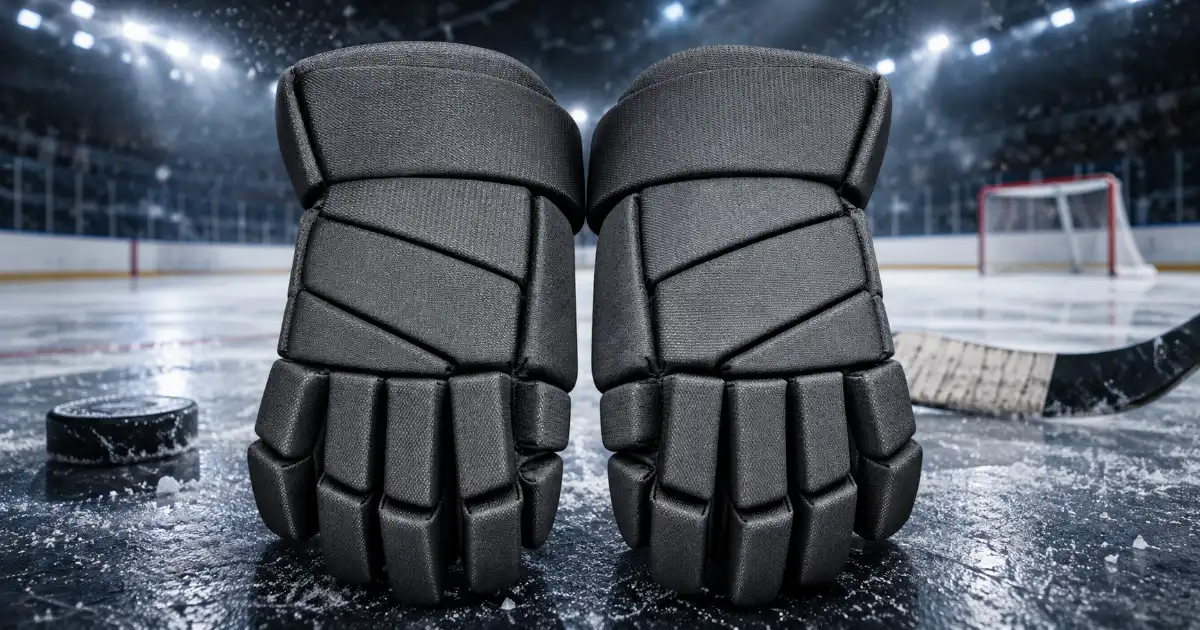
Hockey gloves do much more than keep your hands warm and give you something to grip your stick with. They are an important piece of protective equipment designed to help shield your hands, fingers, wrists, and lower forearms from the everyday impacts that come with playing hockey.
Sticks get swung. Pucks get blocked. Players battle along the boards. Hands end up in places where they can easily take a slash, catch a puck, or get knocked against the ice.
At the same time, hockey gloves cannot simply be bulky pieces of armor. Players need enough mobility and feel to stickhandle, pass, shoot, and control their sticks.
Here is how the different parts of a hockey glove work together to provide protection without taking away the movement your hands need on the ice.
Why Your Hands Need Protection in Hockey
Your hands are exposed to several types of contact during a hockey game.
A stick can catch the back of your hand during a puck battle. A shot or pass can strike your fingers. Your hands can hit the boards or ice during a fall. Even routine stick-on-stick contact can occasionally end up becoming stick-on-hand contact.
Hockey gloves are designed to place protective materials over vulnerable areas while still allowing your fingers, thumbs, and wrists to move.
That combination of protection and mobility is what makes a hockey glove different from simply wrapping your hands in thick padding.
Backhand Protection
The back of the hand presents a relatively large target and can be exposed to slashes, pucks, and other impacts.
That is why the backhand is one of the most heavily padded areas of a hockey glove.
Most modern hockey gloves use layers of protective foam across the back of the hand. Depending on the glove, manufacturers may also incorporate plastic inserts or other reinforcing materials to help distribute and absorb impact.
Rather than using one large, rigid piece, the protection is typically divided into sections. This allows the glove to bend as your hand moves while keeping protective material over the back of your hand.
It is a recurring theme throughout hockey glove design: protect the player without unnecessarily restricting movement.
Finger and Knuckle Protection
Your fingers need even more flexibility than the back of your hand.
Think about how much they move while you play. Your grip changes while stickhandling, shooting, reaching for a puck, or adjusting your hand position on the shaft.
Hockey gloves address this with segmented finger protection.
Instead of one rigid piece running the length of each finger, the protective padding is divided into smaller sections that can move relative to one another as the fingers bend.
The knuckles and fingers remain covered while the segmented construction gives your hands the flexibility needed to maintain control of the stick.
Different gloves use different numbers, shapes, and arrangements of these segments, but the basic goal remains the same: combine impact protection with usable finger movement.
Thumb Protection
The thumb presents a different challenge.
Unlike your fingers, your thumb moves across several directions and plays an important role in gripping and controlling your stick. It can also be vulnerable if it is forced backward or struck during play.
Hockey gloves therefore incorporate dedicated thumb protection designed to provide coverage while still allowing enough movement for normal stick handling.
The exact construction varies among manufacturers and models. Some designs use multiple segments or reinforced structures around the thumb to balance protection with mobility.
The result should be a thumb that feels supported without making the glove feel unnecessarily stiff.
Cuffs and Wrist Coverage
Protection does not stop at the hand.
The cuff extends the glove’s coverage toward the wrist and lower forearm, helping protect an area that could otherwise be exposed between the glove and elbow pad.
Cuff designs vary considerably. Some gloves provide a closer-fitting cuff, while others use a more open design that allows greater wrist movement.
Neither approach automatically makes a glove better. Players have different preferences when it comes to wrist mobility, coverage, and how their gloves interact with their elbow pads.
What matters most is avoiding a significant unprotected gap between pieces of equipment while maintaining enough wrist movement to comfortably handle your stick.
The Palm: Protection Meets Stick Feel
The palm has a different job than the heavily padded exterior of the glove.
While the backhand and fingers need substantial impact protection, the palm needs to maintain contact with the stick. Making it excessively thick could reduce the player’s ability to feel and control the shaft.
Hockey glove palms are generally made from materials designed to balance durability, grip, and feel for the stick.
The palm is also one of the areas of a hockey glove most likely to show wear over time.
Repeated friction can gradually thin the material or eventually create holes, particularly around high-contact areas of the hand.
A worn palm does not necessarily mean every protective component of the glove has failed, but significant deterioration is a good reason to inspect the entire glove and consider whether repair or replacement makes sense.
Why Mobility Matters Alongside Protection
More padding does not automatically mean a better hockey glove.
A glove could theoretically provide enormous amounts of coverage, but it would not be very useful if you could barely close your hand around a stick.
Good hockey glove design is a balancing act.
Protective materials need to cover the hands and fingers while segmentation and flexible areas allow the glove to move with the player. The cuff needs to provide coverage without unnecessarily interfering with wrist movement. The palm needs enough durability for regular use while remaining thin enough to preserve stick feel.
That balance is why hockey gloves can look heavily armored from the outside while still allowing the hand, fingers, and wrist to move naturally.
When Hockey Gloves Need to Be Replaced
Hockey gloves take a considerable amount of abuse, and they should be inspected periodically rather than replaced according to a fixed schedule.
Look for obvious damage to the protective padding or exterior shell, loose or torn stitching, damaged thumb components, deteriorated cuffs, and palms that have become excessively thin or developed significant holes.
Pay particular attention to protective areas that have shifted, cracked, or otherwise no longer stay where they are supposed to.
Cosmetic wear alone does not necessarily mean a glove needs to be replaced. The more important question is whether the glove still provides appropriate coverage and remains structurally sound.
And remember that protection starts with proper sizing. A glove needs to stay positioned correctly on your hand while still allowing comfortable movement.
For more help choosing the right size, read our How Should Hockey Gloves Fit? guide.
A Fresh Look for ABHS Hockey Gloves
When it is time to replace a pair of hockey gloves, protection is only part of the decision. Players also have to consider how the gloves feel on their hands, how easily they can move their fingers and wrists, and how comfortable they are holding a stick.
All Black Hockey Sticks recently updated its hockey gloves with new materials and a new visual design. The changes give the gloves an updated look while keeping them consistent with the all-black equipment ABHS is known for.
If your current gloves have worn palms, damaged padding, or have simply reached the point where they need to be replaced, the new ABHS hockey gloves are worth a look.
Protect Your Hands Without Losing Feel
Hockey gloves have a deceptively difficult job.
They need to help protect your fingers, knuckles, thumbs, hands, wrists, and lower forearms from the impacts of hockey while still allowing you to control a stick with precision.
That is why modern hockey gloves combine protective foams, segmented padding, flexible joints, reinforced areas, cuffs, and relatively thin palms rather than simply surrounding the hand with one thick layer of padding.
When all of those pieces work together, you may barely think about your gloves while you play.
And that is exactly what good hockey equipment should allow you to do: focus on the game instead of the equipment on your hands.