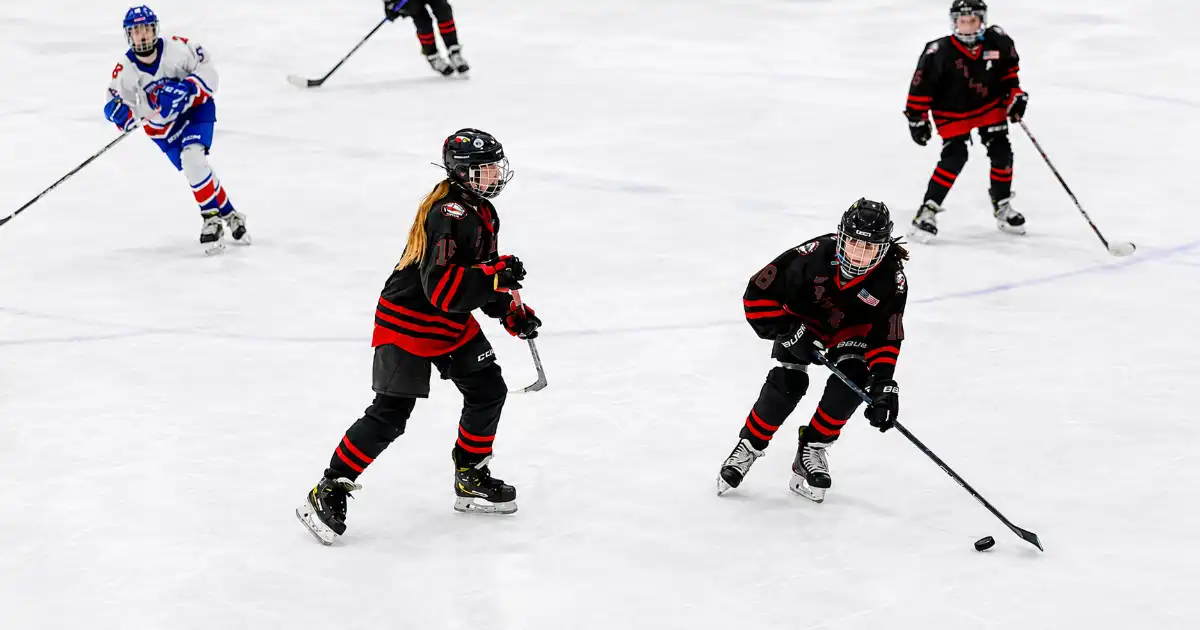
Good stickhandling is about more than moving the puck quickly from side to side. In a game, the real goal is to maintain possession while reading pressure, creating space, and putting yourself in position to make the next play.
Many stickhandling mistakes that lead to turnovers have less to do with a player’s hands and more to do with awareness, positioning, timing, and decision-making. A player can have excellent puck skills in practice and still lose possession regularly if those skills aren’t being used effectively under pressure.
Here are 10 common stickhandling mistakes hockey players make and how to correct them.
1. Watching the Puck Instead of Reading the Ice
Looking down at the puck is natural, especially for developing players. The problem is that every second spent staring at the puck is a second spent not seeing defenders, teammates, open ice, or developing pressure.
Players don’t need to completely stop looking at the puck. Even experienced players use quick glances to confirm its position. The goal is to become comfortable enough with puck control that you can spend more time scanning the ice.
Practice stickhandling while keeping your head up as much as possible. You can also incorporate visual cues into drills, such as having a partner hold up fingers, call out numbers, or move around while you control the puck.
The better you become at feeling where the puck is on your blade, the more attention you can devote to what is happening around you.
2. Leaving the Puck Where Defenders Can Reach It
Extending the puck away from your body can increase your reach and help move it away from pressure. The mistake is leaving the puck where a defender can easily attack it.
Good puck protection is less about always keeping the puck close to your body and more about maintaining separation between the puck and the defender. Depending on where pressure is coming from, that might mean pulling the puck closer, moving it laterally, or extending it farther away on the opposite side of your body.
Your body can act as an additional barrier between the defender and the puck. As pressure changes, the safest puck position changes with it.
Think about puck placement in relation to the defender rather than simply trying to keep it close to you.
3. Overhandling Instead of Moving the Puck
One of the easiest ways to create a turnover is to stickhandle simply because you can.
Extra touches give defenders additional time to close space, establish body position, and take away passing or shooting lanes. Sometimes the best puck-control decision is barely a stickhandle at all.
If a teammate is open, move the puck. If you have a shooting lane, use it. If open ice is available, skate into it.
Stickhandling should help create the next play, not delay it.
Players can work on this by practicing drills with touch or time limits. Forcing yourself to make a decision quickly helps develop the habit of moving the puck before pressure eliminates your options.
4. Trying to Beat One Defender Too Many
Beating a defender one-on-one can create an excellent scoring opportunity. The risk increases when a player successfully gets around one opponent and immediately tries to attack another as additional defenders close on the puck.
Once you’ve beaten a defender, look for what opened up. There may now be a passing lane, shooting opportunity, or open skating lane that wasn’t available a moment earlier.
There are situations where attacking another defender makes sense. The mistake is automatically attempting another move without recognizing that the first one may have already accomplished its purpose.
The successful deke doesn’t have to end with another deke. Sometimes its entire purpose is to create enough space for a simpler play.
5. Using the Same Stickhandling Rhythm Repeatedly
Defenders are looking for patterns.
If every attack follows the same forehand-backhand-forehand rhythm at roughly the same speed, an experienced defender can begin anticipating where the puck is going.
Changing tempo makes puck carriers more difficult to read.
Slow the puck down. Speed it up. Hold it momentarily. Change your hand position. Move laterally. Use your feet along with your hands.
Effective stickhandling isn’t necessarily the fastest stickhandling. A hesitation or change of pace can move a defender’s stick or weight just enough to create an opening.
6. Exposing the Puck Instead of Using Your Body
Your stick isn’t the only thing protecting the puck.
Your hips, shoulders, legs, and skating position can all help create separation between the defender and the puck. Players who rely exclusively on quick hands often leave the puck unnecessarily exposed.
When pressure arrives, try to position your body between the defender and the puck whenever the situation allows. Keep your knees bent, maintain a strong skating position, and use your reach to move the puck away from the defender’s stick.
Puck protection is especially important along the boards, in corners, and when carrying the puck through traffic.
You don’t always need to stickhandle around pressure. Sometimes you can simply keep pressure away from the puck.
7. Receiving Passes Without Planning the Next Play
A turnover can begin before the puck ever reaches your stick.
Players who wait until they receive a pass to decide what to do next often lose valuable time. By then, a defender may already be closing the gap.
Before receiving the puck, scan the ice.
Where is the nearest defender? Is a teammate open? Can you skate into space? Is pressure coming from behind? Do you have enough room to turn?
This habit is often called shoulder checking or scanning. Taking a quick look before the puck arrives gives you information that can make your first touch much more effective.
Instead of receiving the puck and then solving the problem, you’re already beginning to solve it before possession arrives.
8. Stickhandling Into Pressure Instead of Away From It
Players sometimes become so focused on beating a defender that they unintentionally move the puck directly toward the defender’s stick.
Good puck control often means attacking the available space rather than attacking the opponent.
If a defender’s stick is extended to one side, move the puck away from it. If pressure is coming from the boards, look toward the middle or behind you. If a defender is closing quickly, changing direction may be more effective than trying another move.
This is where awareness and stickhandling become inseparable.
Your hands control the puck, but your eyes and brain should determine where it goes.
9. Practicing Moves That Don’t Translate to Games
There’s nothing wrong with practicing creative stickhandling. Toe drags, quick pulls, rapid direction changes, and other moves can improve hand speed and blade control.
The problem comes when nearly all stickhandling practice happens while standing still with unlimited space and no pressure.
Games don’t work that way.
Players have to control the puck while skating, changing direction, dealing with pressure, reading defenders, and making decisions quickly.
Try adding movement and pressure to stickhandling practice. Work around obstacles while skating rather than standing still. Have a partner apply passive pressure. Combine puckhandling with passing or shooting. Give yourself limited time or space to complete a drill.
The closer practice gets to actual game demands, the more useful those skills become.
10. Ignoring the Importance of Simple Puck Protection
Not every possession needs to create a highlight.
Sometimes the correct play is protecting the puck for another second, moving it safely to a teammate, putting it into an area where your team can recover it, or simply avoiding a dangerous turnover.
Where you are on the ice should influence how much risk you take. Losing possession deep in the offensive zone may give your team an opportunity to pressure and recover the puck. Turning it over near the offensive blue line can send the other team the opposite direction with numbers, while a careless turnover in your own zone can quickly become a scoring chance.
Good players learn when to attack and when the smarter play is simply maintaining possession.
That judgment may not look as impressive as dangling a defender, but it can be far more valuable over the course of a game.
Better Stickhandling Starts With Better Decisions
Improving your hands certainly helps you become a better puck carrier, but eliminating stickhandling mistakes requires more than practicing faster moves.
Keep your head up. Scan before receiving the puck. Protect it with your body. Change your pace and rhythm. Move the puck when a teammate has a better option. Most importantly, recognize when the simple play is the right play.
The best stickhandlers aren’t necessarily the players who touch the puck the most. They’re the players who can control it while continuing to see the game developing around them.
When puck control and decision-making begin working together, fewer possessions end with the puck on an opponent’s stick.