
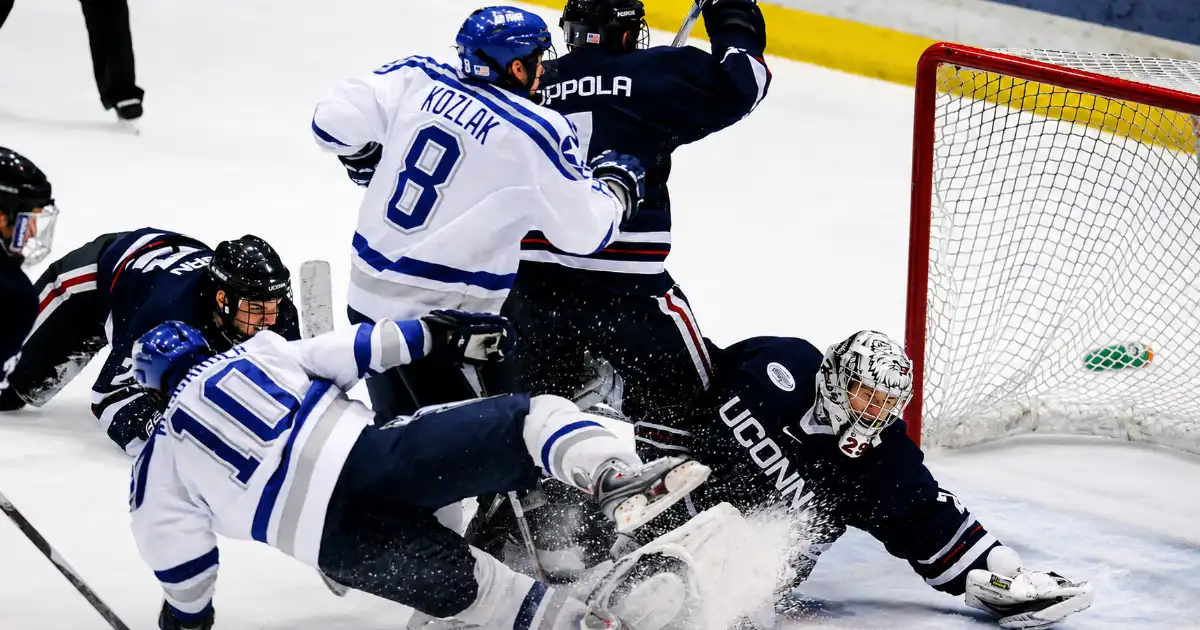
Hockey moves fast enough that the puck does not always stay where everyone expects it to. Every once in a while, a shot or deflection sends the puck somewhere unusual: inside a player’s jersey, between pieces of protective equipment, or into a goalie’s gear.
That creates an obvious problem. Nobody can play a puck they cannot find.
So what happens if the puck gets lodged in a player’s equipment? In most situations, play is stopped once the officials determine the puck is trapped or otherwise unplayable. What happens next depends on where the puck ended up, whether the player did anything intentionally, and what occurred before the stoppage.
When Play Is Stopped
A puck bouncing off a player or briefly disappearing from view does not necessarily result in an immediate whistle. Officials may allow play to continue if the puck remains loose and playable.
The situation changes when the puck becomes trapped or disappears from the referee’s sight during play.
NHL Rule 85 addresses situations involving an unplayable or out-of-sight puck. When the puck becomes inaccessible or is out of the referee’s sight in circumstances requiring a stoppage, the referee blows the whistle and stops play.
That can lead to some strange moments when everyone on the ice knows the puck has disappeared but nobody is quite sure where it went.
What Happens If the Puck Is Stuck in a Goalie’s Equipment?
Goaltenders are the most likely players to make a puck disappear.
A shot can become caught in a goalie’s pads, pants, chest protector, blocker or other equipment. More commonly, the referee simply loses sight of the puck during a scramble around the net.
Under NHL Rule 85.3, when a scramble occurs and the puck is out of the referee’s sight, the referee is required to immediately blow the whistle and stop play. Officials do not have to wait to see whether the puck might eventually work itself loose.
Occasionally, the whistle comes just before the puck squirts free. That can frustrate the attacking team, especially if the loose puck immediately ends up in the net.
There is another important wrinkle here: the NHL’s intent to blow the whistle principle. Play can be considered stopped when the referee determines that the play is dead, even if the audible whistle comes a fraction of a second later. That is why a puck appearing from underneath a goalie and entering the net does not necessarily mean the goal will count.
We took a closer look at that concept in our article, Intent to Blow the Whistle: Why This Hockey Rule Is So Important.
What If the Puck Gets Caught in a Skater’s Equipment?
Skaters can become accidental puck carriers too.
A puck might drop into the back of a player’s pants, become caught inside a jersey or get wedged between pieces of protective equipment after a shot or collision.
If the puck becomes trapped and is no longer playable, play is stopped.
The important distinction is whether the situation happened accidentally.
A player is not normally penalized simply because a puck takes an unfortunate bounce and becomes stuck in their equipment. Hockey equipment has plenty of gaps, openings and oddly shaped surfaces, and sometimes the puck finds one.
Deliberately hiding or gathering the puck is another matter.
Can a Player Carry or Conceal the Puck?
Players cannot intentionally turn their equipment into a puck-storage compartment.
NHL Rule 67 covers handling the puck and includes specific provisions involving deliberately concealing, gathering or holding it.
That creates an important difference between:
The puck becoming stuck in a player’s equipment accidentally
and
A player intentionally trapping, gathering, carrying or concealing the puck
An accidental trapped puck generally results in a stoppage. Intentionally concealing the puck can result in a minor penalty.
The consequences can become more serious around the goal crease. The NHL has additional rules governing situations in which a defending player deliberately covers, gathers or picks up the puck in the crease. Depending on the circumstances, that can result in a penalty shot. If the goalkeeper has been removed from the ice for an extra attacker, certain deliberate actions by a defending player involving the puck in the crease can instead result in an awarded goal.
So if a puck drops into your equipment on its own, you have encountered a bizarre hockey bounce. If you deliberately put it there and skate away with it, you have invented a very ineffective pocket-based offensive system and potentially earned yourself a penalty.
Where Is the Faceoff After the Whistle?
The faceoff does not automatically take place wherever the player happens to be standing when the puck becomes trapped.
When NHL Rule 85.3 applies to an out-of-sight puck, the resulting faceoff is held at the nearest faceoff spot in the zone where play was stopped, unless another rule requires a different location.
Other circumstances can change that result. If one team caused the stoppage through an action covered by another rule, the league’s applicable faceoff-location provisions determine where play resumes.
That is why two incidents involving a disappearing puck can produce different faceoff locations even though the stoppages initially look similar.
What If the Player Crosses the Goal Line With the Puck?
This is where the situation gets especially interesting.
Imagine a shot becomes lodged inside a player’s equipment and the player then slides, falls or is pushed into the net.
The puck may physically end up across the goal line. Surprisingly, that can result in a goal.
If the puck became lodged accidentally, play has not already been stopped and the puck completely crosses the goal line legally, the fact that it happens to be caught in a player’s equipment does not automatically prevent the goal from counting.
The NHL has dealt with situations very close to this.
In 2013, Phoenix Coyotes goaltender Mike Smith made a save against the Buffalo Sabres in overtime, but the puck became lodged in his equipment. Smith then backed into his own net with the puck still stuck in his gear. Video review determined that the puck had completely crossed the goal line, and Buffalo was awarded the game-winning goal.
A similar oddity occurred in 2018 when Carolina Hurricanes forward Clark Bishop went toward the Anaheim net with the puck lodged beneath his skate. Replay showed that the puck crossed the goal line before the net became displaced, and the goal was awarded.
Those plays demonstrate why simply saying “the puck was stuck in someone’s equipment” does not settle the question.
Officials still have to determine whether the puck entered the net legally, whether play had already been stopped and whether the player deliberately gathered, carried, concealed or directed the puck in a prohibited way.
If the puck became lodged accidentally and legally crosses the line before play is stopped, it can count.
If an attacking player illegally carries, conceals or directs the puck into the net, the apparent goal can be disallowed.
In hockey, even accidentally smuggling the puck into the net can produce a goal, provided you did not actually intend to smuggle it there.
What Happens If the Puck Falls Back Out?
Sometimes the mystery solves itself.
A puck may briefly become caught in a jersey or piece of equipment before dropping back onto the ice. If the officials have not stopped play and the puck becomes loose and playable again, play can continue.
This can create confusing sequences because players may momentarily lose track of the puck while the officials are still watching for it.
Once the referee has determined that play should be stopped, however, the puck becoming visible again does not restart the action. This is another situation where the NHL’s intent-to-blow principle can become important.
It is particularly noticeable around goaltenders. A referee may lose sight of the puck, determine that play should be stopped and then have the puck emerge from underneath or inside the goalie’s equipment immediately afterward.
By that point, the play can already be dead.
Why the Rule Exists
At its core, the rule is about keeping the puck available to both teams.
Hockey is built around players competing for a loose puck. Once that puck becomes physically inaccessible inside someone’s equipment, normal play is no longer possible.
Stopping play also prevents an absurd alternative in which opposing players would have to dig through another player’s equipment trying to recover the puck.
The rules therefore distinguish between an accidental trapped puck, which generally requires a stoppage, and deliberately concealing or controlling the puck in an illegal way, which can bring additional consequences.
The Bottom Line
If the puck gets lodged in a player’s equipment during a hockey game, officials will generally stop play once the puck becomes trapped, out of sight or otherwise unplayable. An accidental bounce into a jersey, pants or protective equipment is treated much differently from a player intentionally gathering, hiding or carrying the puck.
If the puck becomes loose before play has been stopped and remains playable, the game can continue. If it stays trapped or disappears from the referee’s sight, play will be stopped. But if an accidentally lodged puck completely crosses the goal line while play is still live, it can count as a goal.
In hockey, where the puck ends up matters. How it got there can matter even more.