
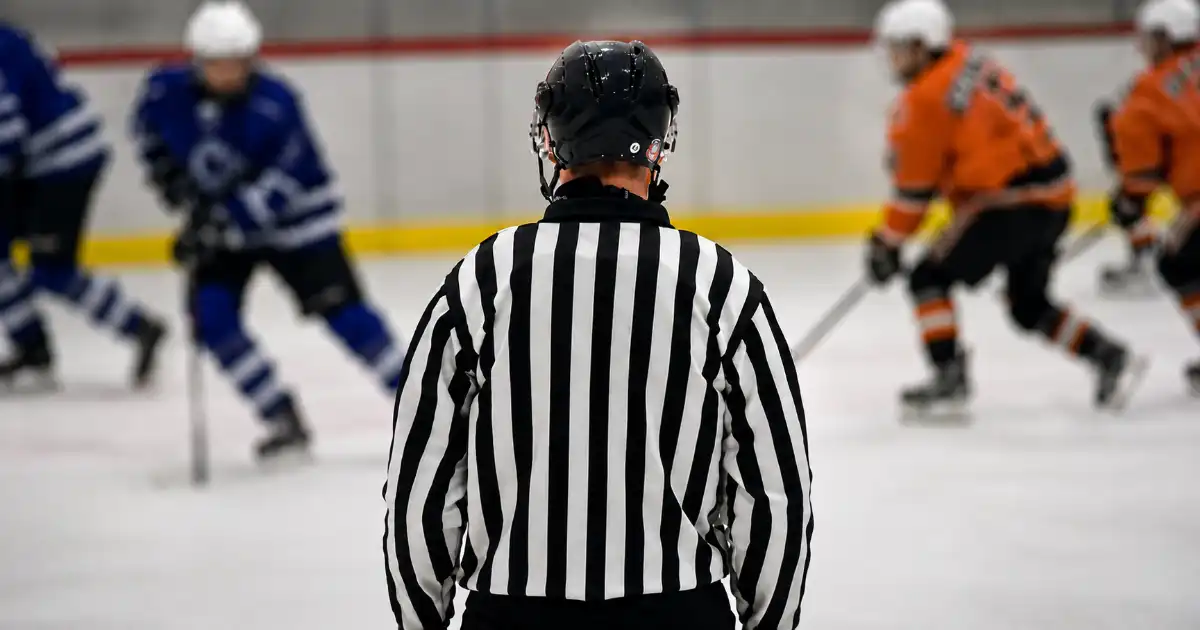
Few things frustrate hockey fans more than seeing the puck cross the goal line only to hear that the goal does not count. Sometimes the whistle seems to come after the puck is already in the net, making the decision even harder to understand.
That is where intent to blow the whistle becomes important.
In hockey, play does not always end at the exact instant you hear the referee’s whistle. In certain situations, officials can determine that play had already been stopped before the whistle was physically blown. Understanding that distinction helps explain some of hockey’s most confusing no-goal decisions.
What Does Intent to Blow the Whistle Mean?
The basic idea behind intent to blow the whistle is simple: a referee’s decision to stop play can occur slightly before the sound of the whistle.
A referee may determine that the puck is covered, frozen or otherwise no longer playable and decide to stop play. There can naturally be a brief delay between making that decision and actually blowing the whistle.
That small gap matters.
If the referee has already deemed the play stopped, something that happens immediately afterward does not necessarily become valid simply because the whistle has not yet sounded.
In other words, the audible whistle is the signal communicating the stoppage. It is not always the precise moment the stoppage occurred.
The Goaltender Example
The situation most commonly associated with intent to blow the whistle happens around the crease.
Imagine a shot reaches the goaltender and the referee loses sight of the puck. From the official’s position, it appears the goalie has possession, so the referee determines the play should be stopped.
A fraction of a second later, the puck becomes visible. Maybe it was sitting underneath a pad without actually being secured, or perhaps it trickles loose and an attacking player knocks it into the net.
Then the whistle sounds.
From the stands or on television, the sequence can look obvious: puck crosses the line, then whistle blows.
That does not automatically make it a goal.
If the referee had already deemed the play stopped before the puck crossed the goal line, the subsequent action occurred after the stoppage, even though everyone heard the whistle afterward.
Why Doesn’t the Actual Whistle Decide Everything?
It would seem simpler to say that play continues until the whistle is heard. The problem is that human reaction time makes that standard difficult to apply fairly.
Officials have to recognize what happened, decide that a stoppage is required and physically blow the whistle. Those actions don’t happen simultaneously.
If the sound of the whistle alone determined the exact end of every play, a puck could potentially be knocked loose or pushed into the net during the brief interval after a referee had already deemed the play stopped.
The intent principle allows the ruling to reflect the referee’s actual decision rather than the fraction of a second required to communicate it.
Why Referees Lose Sight of the Puck
From a television angle, it can be difficult to understand how a referee could lose sight of a puck that appears clearly visible on replay.
The referee, however, does not have an overhead camera.
Officials are watching the play at ice level while players move through the crease, sticks converge on the puck and a goaltender’s pads, glove and body can obscure it almost instantly. A puck may disappear underneath equipment and then emerge somewhere else a moment later.
When the referee loses sight of the puck and reasonably believes the goaltender has secured it, stopping play protects the goaltender and prevents players from continuing to jab and slash at an apparently covered puck.
Occasionally, the official will discover almost immediately that the puck was still loose.
That’s when intent to blow the whistle becomes particularly noticeable.
Why a Goal Can Be Disallowed Even When Replay Shows the Puck Was Loose
This is one of the hardest parts of the rule for fans to accept.
A replay might clearly show that the puck was never completely covered. It might even show the puck crossing the goal line before the whistle can be heard.
But replay footage does not necessarily change when the referee determined that play had stopped.
The important question isn’t simply:
When did everyone hear the whistle?
It is also:
When did the referee deem the play stopped?
When the referee has already deemed the play stopped, video showing that the puck remained loose does not by itself turn the subsequent action into a goal.
Video review can answer many factual questions about a play, but it cannot erase every judgment involved in the original stoppage.
The Rule Can Work Both Ways
Intent to blow the whistle is usually discussed when an attacking team loses a goal, but the principle isn’t designed specifically to favor goaltenders or defending teams.
It establishes a consistent point at which the referee considers play stopped.
Without that principle, players could be encouraged to continue digging at the puck until they physically hear a whistle, even when the referee has already determined the goaltender has possession. That would create more unnecessary contact around the crease and make stoppages less predictable.
Players are still taught to play until the whistle, and that remains good practical advice. The officiating standard simply recognizes that the referee’s determination and the audible signal may be separated by a very short amount of time.
Why These Calls Cause So Much Confusion
The biggest problem is that fans experience the play differently from the referee.
We hear the whistle.
We see the puck.
We may then watch several slow-motion angles showing exactly where the puck was throughout the play.
The referee has none of those advantages when making the initial decision. The official is reacting in real time from one position on the ice.
That creates situations where video can make a decision look incorrect even though the referee’s original judgment explains why the play was stopped.
It may still be frustrating, especially when a potential goal disappears from the scoreboard, but the sequence makes more sense once you understand that the sound of the whistle and the legal stoppage of play are not necessarily the same instant.
Is Intent to Blow the Whistle the Same in Every Hockey League?
The principle is recognized in major hockey rulebooks, including the NHL and IIHF, although the exact wording, procedures and video-review rules can differ between organizations.
That distinction matters when discussing individual plays.
A ruling that applies in an NHL game should not automatically be assumed to work exactly the same way in youth, amateur or international hockey. Rulebook language, video-review procedures and the situations officials are instructed to consider can vary.
For players, coaches and parents, the safest approach is to consult the rulebook governing the specific league or competition when a particular ruling is in question.
Why Intent to Blow the Whistle Matters
Hockey moves too quickly for a referee’s decision and the sound of a whistle to occur at precisely the same instant every time.
The intent to blow the whistle principle accounts for that reality.
It gives officials a way to establish when they determined a play was over, particularly during chaotic situations around the net where the puck can disappear and reappear in fractions of a second.
So the next time the puck enters the net just before you hear the whistle, don’t assume the timing of the sound settles the argument. In hockey, the more important moment may have happened just before anyone heard it.