
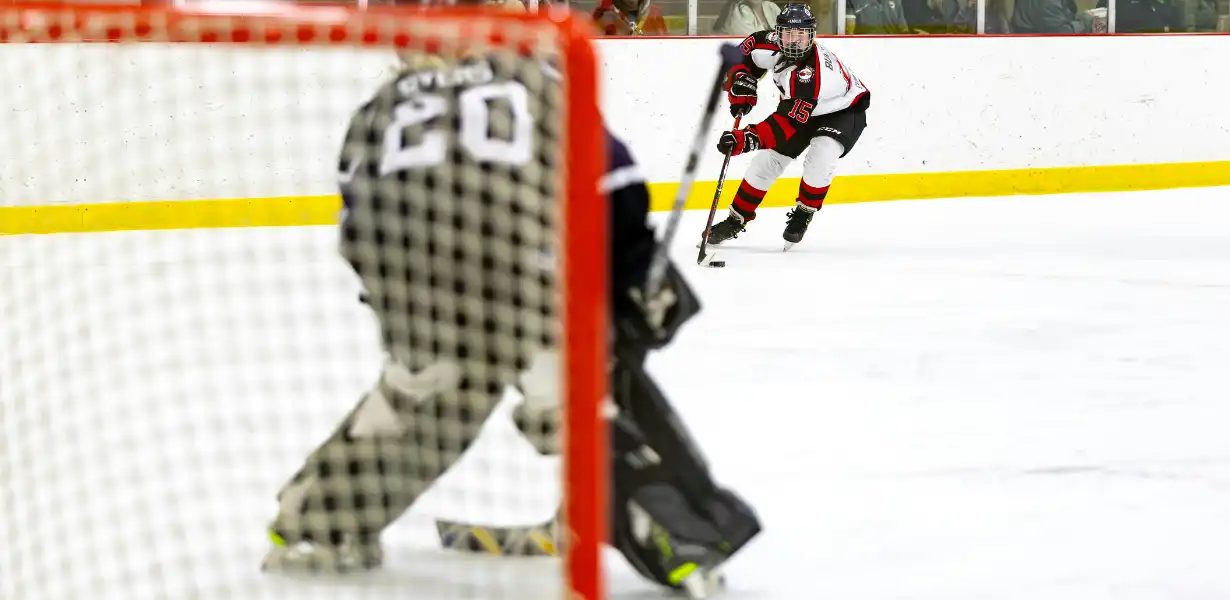
A few days away from the rink can be great for the mind, but the moment you pick up your stick after a holiday break, you might notice your release feels a touch sluggish, your accuracy a bit loose, and your timing just slightly off. That’s totally normal. Even top-level players experience a little post-feast rust in their shot mechanics. The key is knowing how to reset fast so you can fire the puck with your usual authority.
This guide walks you through the foundations that drive both velocity and accuracy: weight transfer, blade control, and follow-through. To help you rebuild your rhythm quickly, you’ll also get short, targeted off-ice shooting sessions designed to restore your mechanics without pounding your body after time off.
Weight Transfer: The Power Source Behind Every Strong Shot
To rebuild velocity, you must reconnect with the true engine of a shot: your lower body. Powerful shooters don’t rely on their arms alone. Instead, they drive force upward through the legs, hips, and core before it travels down the shaft and into the puck.
Reset Your Foundation
After taking time off, many players return with their stance too tall or too narrow. Before you start firing pucks, reestablish your athletic base:
• Keep knees flexed and hips unlocked
• Set your chest tall but not rigid
• Distribute weight slightly forward, not on your heels
• Stay balanced with a stance wide enough for stability but flexible for rotation
Think of this as the base note of your shot—the part everything else is built on.
Rebuild the Load Phase
A strong wrist shot or snapshot depends on loading force into the back leg. Without that load, the puck leaves the blade without real authority. To sharpen this:
• Start with the puck slightly ahead of your back foot
• Feel the weight shift naturally—not exaggerated
• Rotate your hips toward your shooting lane as you prepare to fire
Then, drive forward through your front foot, creating a smooth transfer of energy. The more fluid this sequence, the more consistent your shot velocity becomes.
Blade Control: The Key to Precision and Shot Confidence
Even the strongest shot can miss the net by a mile without clean blade contact. Blade control is where accuracy is built, refined, and reinforced—especially after a few days of rest.
Reconnect With Your Sweet Spot
Every blade has a natural puck-handling zone that gives you the best blend of stability and control. To regain your accuracy:
• Place the puck just forward of the blade’s midpoint
• Practice settling the puck there in slow, simple movements
• Maintain a consistent blade angle as you shift the puck across your body
Feel that soft, confident connection between blade and puck. Once that returns, accuracy starts to climb immediately.
Top-Hand Strength, Bottom-Hand Guidance
The top hand sets direction. The bottom hand shapes blade angle. Post-break rust usually shows up through unnecessary tension. Reset with this approach:
• Keep a firm but mobile top hand
• Allow the bottom hand to glide, not choke
• Focus on crisp wrist movement during release
This combination helps you avoid wobbly blade contact and ensures the puck exits the stick with intention, not guesswork.
Blade Angle Discipline
Your blade angle determines the puck’s trajectory. Use it with purpose:
• Closed blade: Lower, faster shots
• Neutral blade: Controlled, accurate wrist and snap releases
• Slightly open blade: Quick lifts in tight
Work each angle independently. By mastering subtle adjustments, your accuracy tightens across all shot types.
Follow-Through: The Final Steering Wheel of Your Shot
Follow-through is the difference between “almost” and “dialed in.” Once your blade meets the puck, your stick path and body finish determine how true your shot flies.
Stick Finishes Where Your Puck Should Go
It’s one of the most universal shooting cues in hockey. Finish your stick toward your intended target—it reinforces direction and maintains a stable exit path.
This applies especially to wrist and snap shots, where personal mechanics matter as much as raw power.
Match Your Follow-Through to Your Shot Height
Shot height is heavily influenced by blade angle at release, but your follow-through helps keep that height consistent:
• Finish low → low shot
• Finish level → mid-height shot
• Finish high → rising shot
The goal is repeatability. After time off, this consistency helps you find your shot identity again.
Stay Balanced Through the Finish
Avoid landing too far forward or rotating uncontrollably—both rob your shot of control. A proper finish leaves you:
• Stable on your front foot
• Upright through the shoulders
• Ready for the next puck or play
Controlled finishes = controlled shots.
Mini Off-Ice Shooting Sessions to Restore Velocity and Accuracy
These short sessions help rebuild mechanics quickly without overwhelming your body after downtime. Use your high-performance composite stick for all reps.
Session 1: Weight Transfer Tune-Up (10 minutes)
Goal: Restore power sequencing
• 10 no-puck load-to-release motions
• 10 slow, smooth wrist shots focused on leg drive
• 10 hip-rotation snapshots
• 10 full-power shots with full weight transfer
Cue: load → rotate → drive → finish
Session 2: Blade Control Precision (12 minutes)
Goal: Restore accuracy through crisp blade contact
• 20 reps settling puck on sweet spot
• 10 neutral-blade wrist shots
• 10 closed-blade low shots
• 10 slightly open-blade quick lifts
• 10 full-speed shots with chosen angle
Cue: feel the puck first
Session 3: Follow-Through Focus (15 minutes)
Goal: Rebuild directional and height control
• 10 low-stick finishes
• 10 level-stick finishes
• 10 high-stick finishes
• 10 directional snaps (finish to corner target)
• 10 complete, game-pace shots
Cue: finish where you aim
Bringing It All Together
Post-feast rust fades fast when you lean into technical fundamentals. By focusing on weight transfer, sharpening blade control, and finishing every release with a disciplined follow-through, you rebuild both velocity and accuracy in a matter of days. Combine these with short, consistent off-ice sessions, and you’ll feel your shot tighten up just as quickly as it loosened during the break.