
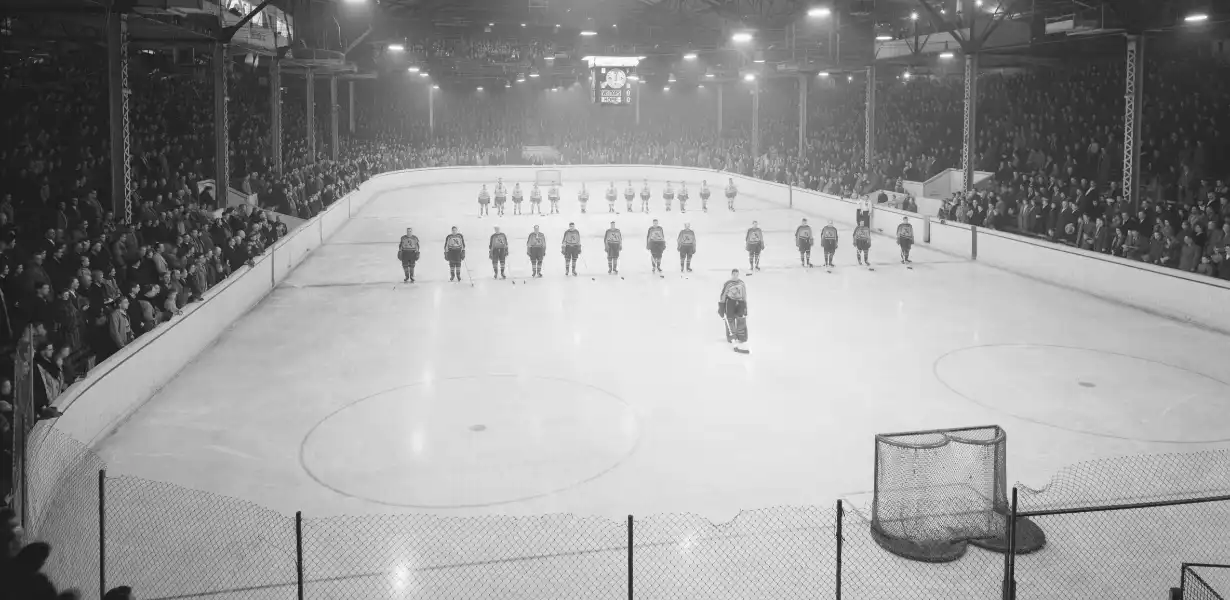
Hockey fans love a wild story, and the sport’s early rulebook is stacked with details that would blow the mind of anyone used to today’s NHL pace. From chaotic benches to goaltenders forbidden from dropping to the ice, the evolution of hockey rules reads like a highlight reel of ingenuity, improvisation, and pure grit. Let’s take a deep skate through some of the most surprising historical hockey rules—ones that would leave today’s players and fans staring in disbelief.
No Forward Passing — Imagine the Breakouts!
Before 1929, the NHL prohibited forward passing in both the neutral zone and offensive zone. Limited forward passing in the defensive zone existed earlier, but full-rink forward passing didn’t become legal until the 1929–30 rule overhaul.
Offense before that relied on individual rushes, on-the-spot creativity, and lateral or backward movement. Imagine a modern winger trying to fire a stretch pass up ice… only to get whistled down for attempting something beginners do without thinking today.
The rule contributed to low-scoring, grinding play that leaned heavily on puck possession and physical battles. Breakaways were rare, and odd-man rushes almost nonexistent. Modern fast-transition hockey would look like pure magic to fans from that era.
Goalies Couldn’t Drop to the Ice
Until 1917, goaltenders weren’t allowed to leave their feet—dropping to the ice to make a save was illegal. They were expected to stop shots while remaining upright, using leg kicks, reach blocks, or awkward leans to cover as much net as possible.
Players exploited this restriction by firing shots low along the ice, knowing that goalies could not commit their bodies downward. Once the NHL officially permitted goaltenders to leave their feet, the position evolved rapidly, eventually giving rise to butterfly technique, paddle-down coverage, and the athletic style fans marvel at today.
No Blue Lines — Early Hockey Was Unlimited Ice
Before the 1918–19 season, the rink had no blue lines and therefore no defined zones. Offside existed in varying historical forms, but the ice was effectively one giant, fluid playing space.
Offensive rushes could begin anywhere, defensive structure was loose, and the pace vacillated between chaotic sprints and grinding scrums. The introduction of blue lines reshaped hockey by creating distinct offensive, defensive, and neutral zones—adding structure without sacrificing the sport’s speed.
The Rover Position — A Seventh Skater on the Loose
Early organized hockey used seven skaters per team, including the rover—a free-floating position without a fixed assignment. The rover supported both offense and defense, often acting as a dynamic wild card who read the play and reacted instinctively.
As the sport matured, leagues eliminated the rover throughout the 1910s and 1920s in favor of the now-standard six-player lineup. Still, the spirit of the rover lives on in today’s hybrid-style defensemen and high-motor forwards who blur positional lines.
No Substitutions During Play
Early hockey did not permit substitutions during active play. Teams had to wait for a whistle, and in some of the earliest rule sets, substitutions were restricted to injury situations only.
The lack of on-the-fly changes led to extremely long shifts. Players remained on the ice for exhausting stretches, which noticeably slowed the pace later in games. Today’s rapid 30–50-second shift structure would seem like a luxury unimaginable to players of the early game.
Only One Referee on the Ice
For much of hockey’s early history, games were officiated by a single referee, occasionally supported by goal judges but without the second referee or linesmen system that fans know today.
With one individual trying to monitor all the action—stick battles, scrums, positioning, and the rover’s unpredictable movements—missed calls were common and disputes even more so. The sport’s eventual adoption of a multi-official team dramatically increased oversight, consistency, and game management.
Wooden Pucks and Evolving Equipment
Before standardized vulcanized rubber pucks became the norm, players sometimes used wooden pucks or other improvised materials. These early pucks bounced unpredictably, especially on uneven natural ice surfaces.
Equipment was equally inconsistent, often heavy and minimally protective. Early sticks were simple wooden constructions prone to warping or breaking. Today’s precision-engineered gear highlights just how far materials science has transformed the game.
No Glass Around the Boards
Originally, rinks had no protective glass, meaning fans sat directly beside the action. Pucks regularly entered the crowd, collisions spilled over the boards, and the viewing experience—while thrilling—came with genuine physical risk.
Glass became common in North American arenas only in the mid-20th century, enabling modern gameplay staples like rim-arounds, bank passes, and sealed boards for forechecking pressure.
The Two-Line Pass Rule — A Mid-Ice Barrier
From 1943 to 2005, hockey’s two-line pass rule prevented players from receiving a forward pass that crossed both the defensive blue line and the center red line. The intent was to prevent “cherry-picking,” but the effect was slower transitions and fewer fast-break opportunities.
When the NHL eliminated the rule for the 2005–06 season, scoring chances increased, and the pace of play dramatically accelerated—perfect for modern speed-driven stars.
Goal Judges Behind the Net
Long before replay systems and overhead cameras, rinks employed goal judges stationed directly behind each net. Using a handheld button connected to a red light, they signaled when a puck crossed the goal line.
Their angle wasn’t always perfect, and disputes were common, especially on close plays. Nonetheless, goal judges were a critical part of the sport’s officiating infrastructure until technology modernized the process.
Hockey Keeps Evolving, and Fans Keep Loving It
These historical rules highlight how dramatically hockey has changed over the last century. What once seemed logical now feels unthinkable, and the sport’s constant evolution reflects generations of innovation, competition, and love for the game.
Today’s players benefit from faster ice, advanced equipment, refined strategy, and a rulebook crafted for speed and skill. Yet the heart of the sport—teamwork, intensity, and the thrill of the puck hitting twine—remains the same.