
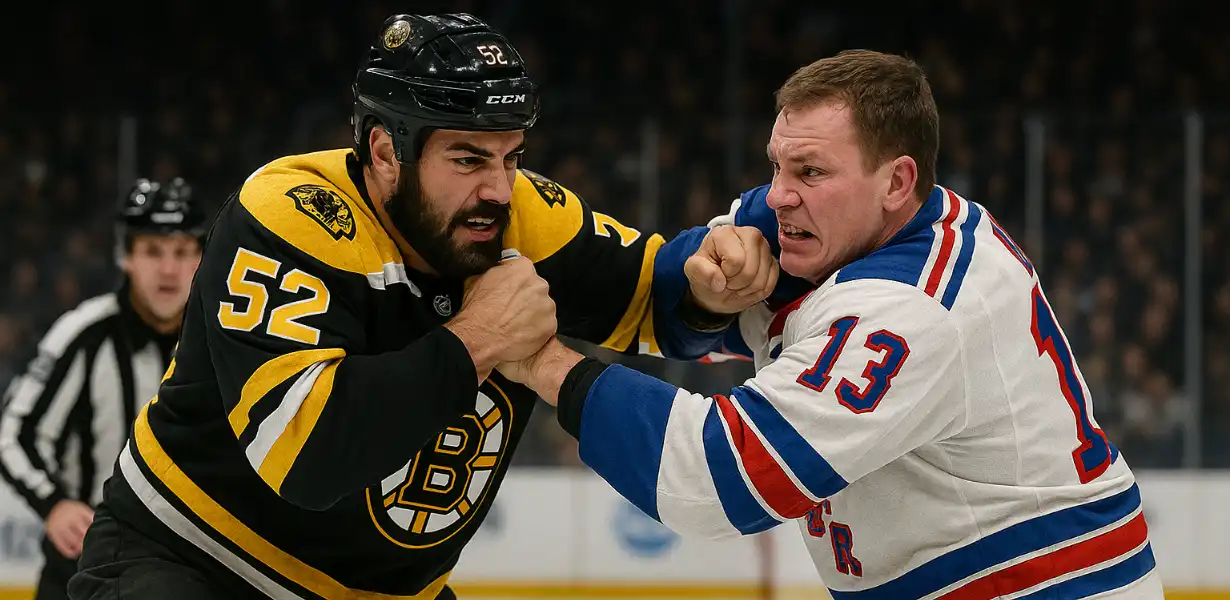
Hockey has always been a sport defined by speed, skill, and toughness. Few aspects of the game capture its physical intensity more than the tradition of fighting. Unlike other professional sports, hockey developed a unique way to regulate on-ice altercations: the five for fighting rule. This penalty, now iconic within the game, didn’t appear overnight. Instead, it emerged from decades of evolving attitudes toward physical play, player safety, and the culture of accountability on the ice.
In this article, we’ll explore the origins of the five for fighting rule, how it became embedded in hockey tradition, and the role it continues to play in shaping the sport.
What Does “Five for Fighting” Mean?
Before diving into history, it’s worth understanding what the five for fighting penalty actually is. In hockey, if two players drop their gloves and engage in a fight, both participants are typically assessed a five-minute major penalty. This means they serve five minutes in the penalty box, leaving their teams temporarily shorthanded.
The phrase five for fighting has since become part of hockey folklore, symbolizing the sport’s acceptance of controlled physical confrontation. But how did it begin?
The Early Days of Hockey and Rough Play
In the late 19th and early 20th centuries, when organized hockey was still developing, rules were far less standardized than they are today. Physicality was already a defining feature of the game, and fights often broke out without consistent punishment. In some leagues, fighting was simply tolerated; in others, it led to disqualification.
As hockey professionalized in the early 1900s, especially with the rise of the National Hockey Association (NHA) and later the NHL in 1917, league officials recognized the need for clear rules around fighting. The aim wasn’t necessarily to eliminate it, but to regulate it in a way that kept games from spiraling out of control. This was the seed that grew into the five for fighting standard.
Establishing the Five for Fighting Rule
By the 1920s and 1930s, the NHL began implementing structured penalties for fighting. Instead of ejecting players outright, referees started assigning major penalties. The duration settled on five minutes, long enough to discourage endless brawls but short enough to avoid completely removing key players from the action.
The logic was simple: fighting was seen as a way for players to police themselves, discourage cheap shots, and maintain respect on the ice. Rather than eliminating fights entirely, the five for fighting penalty created a balance—punishing the act but acknowledging its place in the culture of the sport.
Why Five Minutes?
The decision to make the penalty five minutes instead of two (a minor) or ten (a misconduct) reflected compromise. A two-minute minor would have made fighting too easy to brush off, while a ten-minute penalty risked being too severe, especially in an era when star players were central to a team’s success.
Thus, the five for fighting penalty struck the right middle ground. It gave players a serious consequence while still allowing them to rejoin the game and continue contributing.
Five for Fighting and the Enforcer Era
The rule gained further significance during the “enforcer” era of hockey, particularly from the 1970s through the 1990s. Teams often employed players whose primary role was to protect stars and intimidate opponents. These enforcers were masters of the five for fighting penalty, using it as a tool to maintain order and rally their teammates.
In this period, the five for fighting penalty became almost ritualized. Fans expected fights, players respected the code, and the five-minute major was the price of doing business. The penalty box, in many ways, became a stage where toughness and team loyalty were displayed.
Cultural Impact of the Five for Fighting Rule
Beyond the rink, the five for fighting concept spilled into popular culture. It became shorthand for toughness, grit, and standing up for oneself. The term was immortalized in highlight reels, commentary, and even music, reinforcing hockey’s unique identity among professional sports.
The enduring presence of five for fighting reflects how hockey has always balanced artistry and aggression. It’s a penalty, but also a tradition—a reminder that hockey’s physical edge is part of what makes the game thrilling.
Modern Changes and Debates
Today, the five for fighting rule remains part of hockey, but its role has evolved. With growing awareness of concussions and player safety, fights have become less common in the NHL compared to decades past. Some argue that the five for fighting penalty still serves as a valuable deterrent against dirty play, while others believe it has no place in the modern game.
Despite these debates, the penalty continues to be enforced consistently. Its very existence underscores hockey’s willingness to acknowledge its physical roots while adapting to modern expectations.
Final Whistle
The five for fighting rule is more than just a line in the rulebook—it’s a piece of hockey’s DNA. Born from the need to manage rough play in the early days of the sport, it evolved into a defining feature of professional hockey. From protecting players to fueling rivalries, it has shaped the game’s culture in ways few other rules have.
While fighting may be less frequent today, the tradition of five for fighting lives on as a symbol of hockey’s balance between skill, speed, and toughness. It reminds fans and players alike that hockey isn’t just about scoring goals—it’s about standing up, showing grit, and embracing the spirit of the game.