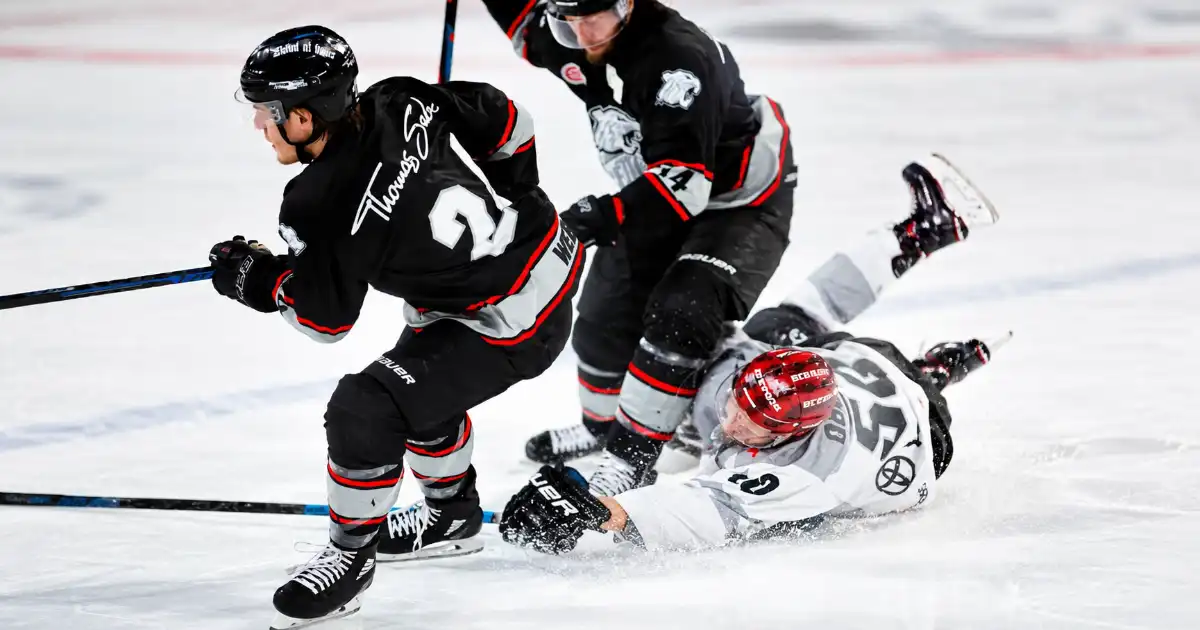
Hockey is a fast, physical sport, and players are constantly being bumped, hooked, tripped, and knocked off balance. Sometimes that contact results in a penalty. Other times, a player may make the contact look a little more dramatic in hopes of convincing an official to make a call.
That is where embellishment comes in.
Embellishment in hockey occurs when a player exaggerates the effect of contact or otherwise tries to make an infraction appear worse than it really was in an attempt to draw a penalty. It can be one of the more confusing calls in hockey because an official can determine that a player was legitimately fouled and still penalize that player for embellishing the reaction.
What Does Embellishment Mean in Hockey?
The NHL addresses diving and embellishment under Rule 64. A player can receive a minor penalty for actions intended to draw a penalty, including exaggerating a fall or reaction or feigning an injury.
In simple terms, the question is not always whether contact occurred. The question can also be whether the player’s reaction reasonably matched that contact.
Imagine a player feels an opponent’s stick around their hands. The contact might legitimately qualify as hooking, but if the player dramatically throws both arms into the air and falls backward in an attempt to make the hook more obvious, an official could determine that the reaction was exaggerated.
That creates one of hockey’s stranger-looking situations: both players can end up in the penalty box.
Can Both Players Get a Penalty?
Yes. An official can call the original infraction and embellishment on the same play.
For example, one player might receive a two-minute minor for holding while the opponent receives a two-minute minor for embellishment. The official is essentially saying that the first player committed a penalty, but the second player unnecessarily exaggerated what happened in an attempt to influence the call.
That can be confusing from the stands. If the player was actually held, how could the reaction also be embellishment? The two calls address different actions. The holding penalty addresses the illegal contact, while the embellishment penalty addresses how the other player reacted to it.
There are real NHL examples of exactly this situation. In March 2026, Montreal’s Josh Anderson was called for holding Anaheim’s Beckett Sennecke, while Sennecke received an embellishment minor on the same play. The two penalties were offsetting.
It’s one of those hockey situations that can look contradictory until you understand what the officials are actually calling. Hockey has quite a few of those, as we covered in The Weirdest Rulebook Situations That Actually Happen in Hockey.
Is Embellishment the Same as Diving?
Hockey fans often use the terms diving and embellishment a little differently, although the NHL addresses them together under Rule 64 rather than treating them as two completely separate offenses.
Generally, fans use “diving” to describe a player attempting to create the appearance of an infraction, particularly when little or no illegal contact occurred. “Embellishment” is more commonly used when a player exaggerates the effect of contact that actually happened.
For example, if a stick barely brushes a player’s skate and the player deliberately falls in an attempt to draw a tripping call, most fans would probably describe that as a dive. If a player is legitimately hooked but dramatically throws their arms into the air to emphasize the contact, they might describe that as embellishment.
Either way, the basic idea is the same: a player is trying to make an infraction appear more obvious or more severe in an effort to influence the call.
What Are Officials Looking For?
Officials have to make these decisions at game speed, so there isn’t a simple formula for identifying embellishment. They may consider whether a player’s reaction appears consistent with the amount and direction of contact, whether the player seems to deliberately throw themselves to the ice, or whether there is an exaggerated reaction designed to draw attention to an opponent’s stick or body contact.
Context matters. Hockey players routinely lose their balance because of legitimate contact, especially while skating at speed, changing direction, battling along the boards, or controlling the puck. Falling after contact does not automatically mean a player embellished.
The difficult part for an official is deciding whether the contact caused the reaction or whether the player added something extra.
Why Does Hockey Penalize Embellishment?
Penalties can have an enormous effect on a hockey game. A successful attempt to manufacture or exaggerate a call could give a team a power play and potentially affect the score.
Rules against diving and embellishment are intended to discourage players from trying to convince officials to call penalties that either did not happen or were made to look more severe than they actually were.
There is also a practical reason for the rule. If exaggerated reactions routinely resulted in penalties against opponents, players would have an incentive to exaggerate more often. Penalizing embellishment gives officials a way to discourage that behavior.
Can NHL Players Be Punished After the Game?
Yes. At the NHL level, enforcement does not necessarily end when the final horn sounds.
NHL Hockey Operations can review potential diving and embellishment incidents after games, including plays where an embellishment penalty was not called on the ice. Under the league’s system, a player’s first citation results in a warning, while subsequent citations can result in escalating fines. Repeated violations can eventually result in fines for a team’s head coach as well.
That gives the league an opportunity to review questionable plays from multiple camera angles instead of relying entirely on what an official could see during a fraction of a second at game speed.
What About Embellishment in Youth Hockey?
Parents and young players should remember that specific rules and terminology can vary depending on the league and governing body. NHL rules should not automatically be assumed to apply exactly the same way in a youth hockey game.
The larger lesson, however, translates well to younger players: keep playing through normal contact rather than trying to sell a call. Officials will miss penalties, and they will occasionally make calls that players, coaches, or parents disagree with. Exaggerating contact can create another problem instead of fixing the first one.
For young players especially, continuing to skate and staying involved in the play is usually a much better habit than looking toward an official and waiting for a call.
A Penalty Can Be Real and Still Be Embellished
That is the part of the rule that is easiest to misunderstand. An embellishment call does not necessarily mean the official decided that nothing happened. Sometimes the official is saying that something illegal happened, but the player’s reaction made it look worse than it actually was.
That is why you may occasionally see both players skating toward the penalty box after what appeared to be a single infraction. One player committed the foul, while the other tried a little too hard to make sure everyone noticed it.